Summarise with AI
- Uzm. Dr. Hasan Keleş
- November 4, 2026
- 3 min read
- Newborn
- — reads
A baby whose eye waters even when not crying and who wakes up in the morning with lashes stuck together by discharge... Most of the time the cause is a tear duct that has not yet fully opened, and in the great majority of babies it clears up on its own. In this article we explain the symptoms of a blocked tear duct, cleaning the eye at home, massage, when it clears up and which signs mean you should see a doctor without waiting.
What is a blocked tear duct?
Tears flow from small openings at the inner corner of the eye into thin channels and from there into the tear duct, which opens into the nose. According to the American Association for Pediatric Ophthalmology and Strabismus (AAPOS), the most common cause of a blockage is a thin membrane at the end of the duct where it opens into the nose. This membrane is present in about half of newborns and in most of them opens on its own shortly after birth; when it does not open, tears cannot drain into the nose and collect in the eye.
According to the family information leaflet of Cambridge University Hospitals (NHS), up to one in five babies has some of these symptoms.
What are the symptoms?
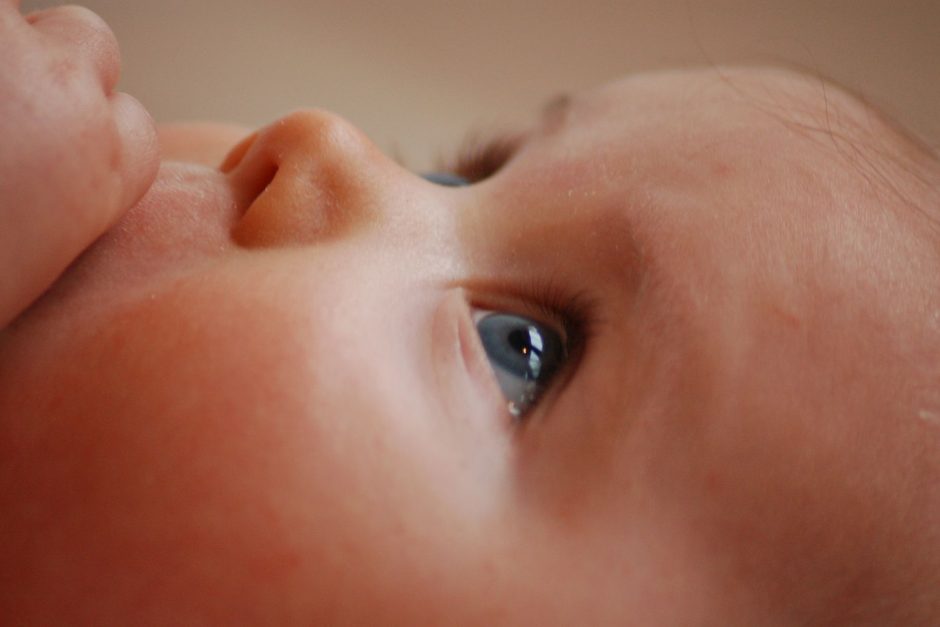
- A watery eye even when the baby is not crying, with tears collecting at the corner of the eye or spilling onto the cheek
- Yellow-green discharge on the lashes and eyelids; lashes stuck together in the morning
- Redness and irritation of the skin of the lower eyelid, which stays wet all the time
According to AAPOS, symptoms usually appear in the first month of life. According to the information leaflet of Hull University Teaching Hospitals (NHS), symptoms can get worse in cold weather and during a cold, which is why stickiness often becomes more noticeable in winter. We explain nose care for a blocked nose in our article on saline drops.
How can it be told apart from an infection?
With a blocked duct the white of the eye usually stays white and the baby is content. A red white of the eye, swollen eyelids and increasing discharge suggest an eye infection (conjunctivitis in children). According to Cambridge University Hospitals, antibiotic drops and ointments make little difference to a blocked duct unless the eye becomes red and very sticky. The doctor decides after the examination whether drops are needed.
Cleaning the eye at home
- Wash your hands; wipe the eyelid from the inner corner outwards with clean cotton wool moistened with cooled boiled water.
- Use a separate piece of cotton wool for each eye; do not use the same piece twice.
- If the skin of the lower eyelid is irritated, keep the area dry.
- Do not put breast milk, tea or herbal water in the eye.
Tear duct massage
According to AAPOS, firm downward pressure with a finger over the inner corner of the eye may help the membrane to open. Hull University Teaching Hospitals advise doing the massage only if a health professional recommends it: wash your hands, press with your little finger between the inner corner of the eye and the bridge of the nose, slide the finger downwards, and do this twice a day with no more than 10 strokes each time. It is best if your doctor shows you the massage the first time.
When does it clear up, and when is a procedure needed?
According to AAPOS, about 90 per cent of cases clear up on their own during the first year. If the blockage continues after 12 months, or if the symptoms are severe, an eye doctor may recommend opening the duct with a fine probe (probing). According to Hull University Teaching Hospitals, a blocked duct does not directly affect vision or the development of the eye. Your baby's development is also monitored at newborn follow-up visits.
When to see a doctor
- If your baby is in the first month of life and the white of the eye is red with heavy discharge
- If there is a painful, red, swollen lump between the inner corner of the eye and the nose (AAPOS describes this as an emergency infection), especially if there is also a fever
- If there is a bluish swelling at the inner corner of the eye; according to AAPOS, this type of swelling can occur together with cysts inside the nose and may affect breathing
See an eye doctor promptly: if the watering comes with sensitivity to light, tight squeezing of the eyes, cloudiness of the clear front surface of the eye or one eye looking larger than the other, the rare condition of childhood glaucoma must be ruled out. AAPOS also advises keeping this serious cause in mind when a baby's eyes water. For other findings that are considered normal in newborns, see our article on normal findings in newborns. You can book an appointment at Özel Düztepe Yaşam Hospital in Şahinbey, Gaziantep.
Frequently Asked Questions
Tears drain through small openings at the inner corner of the eye into a duct that opens into the nose. If the thin membrane at the end of this duct has not yet opened at birth, tears cannot drain into the nose, collect in the eye and spill onto the cheek. According to the American Association for Pediatric Ophthalmology and Strabismus (AAPOS), this is the most common cause and symptoms usually start in the first month.
With a blocked duct the white of the eye usually stays white; the eye waters even when the baby is not crying, and the lashes may be stuck together with yellow-green discharge in the morning. If the white of the eye turns red, the eyelids swell or the baby is in the first month of life, infection must be ruled out; have your baby seen the same day.
According to AAPOS, about 90 per cent of cases clear up on their own during the first year. According to the information leaflet of Cambridge University Hospitals (NHS), symptoms have gone in more than half of affected babies by eight months.
If your doctor has advised it, wash your hands, keep your nails short, press with your little finger between the inner corner of the eye and the side of the nose and slide the finger downwards towards the nose. NHS leaflets advise doing this twice a day, with no more than 10 strokes each time.
There is no reliable evidence that putting breast milk or tea in the eye opens the blockage, and it carries a risk of bringing germs into the eye. Wipe away the discharge with clean cotton wool moistened with cooled boiled water, using a separate piece for each eye.
📅 Book an appointment for your child's health
Book an online appointment with Specialist Dr. Hasan Keleş in Gaziantep — instant confirmation.
Book an Appointment Online