 Uzm. Dr. Hasan Keleş
- August 27, 2026
- 3 min read
- Ear, Nose and Throat
- — reads
Hearing is the precondition for language development. A child cannot imitate a sound they do not hear, and speech begins with imitation. For that reason hearing loss that goes unnoticed affects not only hearing but speech, reading and social relationships.
The good news: newborn hearing screening is widely applied in Türkiye and most congenital losses are picked up early. What needs attention is hearing loss that develops later.
What Newborn Screening Shows — and What It Does Not
Screening is carried out in the first days after birth and shows the situation at that time.
What it does not show is hearing loss that develops later. Causes include meningitis, recurrent middle ear infections, head injury, certain medicines and progressive inherited conditions.
For that reason "he passed the screening" does not remove a concern that arises in later years.
Where a baby does not pass, panic is not needed: a false result on the first test is common because of fluid left in the ear canal from birth. The test is repeated and, where necessary, the baby is referred for further assessment. What matters is not missing the repeat test.
What to Expect at Each Age
Where the following milestones are not met, a hearing assessment is requested:
0-3 months
- Startling at sudden loud sounds
- Settling to a familiar voice
3-6 months
- Turning the head towards a sound
- Repeating their own sounds, babbling
6-12 months
- Responding to their name
- Responding to simple words such as "no" or "come"
- Repeating syllables (ba-ba, da-da)
12-18 months
- Following simple instructions
- First meaningful words
18-24 months
- A marked increase in vocabulary
- Putting two words together
⚠ A baby whose babbling decreases or stops matters particularly. A baby who cannot hear also babbles in the first months; but because they do not hear their own voice, it gradually diminishes and disappears. This is the sign families most often miss.
Signs in Older Children
- Constantly turning up the television
- Frequently asking "what did you say?"
- Not turning when called from behind
- Marked difficulty following speech in noisy places
- Speaking too loudly
- Seeming distracted at school, missing instructions
- Unclear, indistinct speech sounds
- A habit of turning one ear towards the speaker
At school age these signs are often interpreted as "attention problems" or lack of interest. A hearing test should come before that interpretation.
The Commonest Cause: Fluid in the Middle Ear
The commonest cause of temporary hearing loss in childhood is fluid collecting in the middle ear.
There may be no earache and no fever. The child does not look unwell; only their hearing is reduced. The fluid can remain after upper respiratory infections and persist for weeks.
Its characteristic feature is that it fluctuates: worse during colds, better as they clear. The family's description of "sometimes he hears and sometimes he doesn't" usually comes from this.
In children with enlarged adenoids the picture is more common and lasts longer.
Which Tests Are Used?
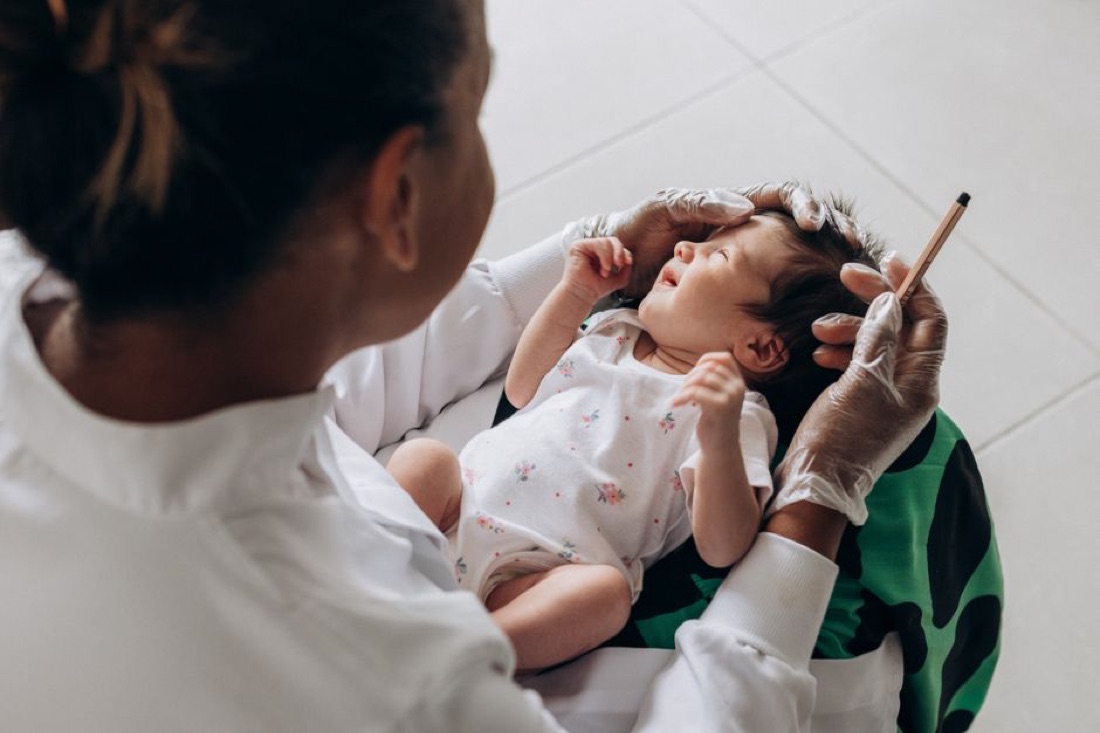
Otoacoustic emissions (OAE): a small probe in the ear measures the response of the inner ear. It is quick and painless and is used in newborn screening.
ABR (auditory brainstem response): measures the transmission of sound along the nerve pathway. It is carried out during sleep in babies and in children who cannot co-operate with testing.
Tympanometry: measures the movement of the eardrum. It shows whether there is fluid in the middle ear; it does not measure the level of hearing but helps identify the cause.
Audiometry: measures the child's response to sounds delivered through headphones. It is used from school age onwards, and play-based versions exist for younger children.
All the tests are painless and do the child no harm.
When to Seek Help Without Delay
- The newborn screening was not passed and the repeat test has not been done
- Babbling has decreased or stopped
- No response to their name at twelve months
- No words at all at eighteen months
- Speech markedly behind that of peers
- After meningitis (hearing is always assessed afterwards)
- Hearing changed after a head injury
- A family history of childhood hearing loss
- Sudden loss of hearing described
The Link with Speech Delay
In every child with speech delay, a hearing test is the first investigation.
The result is usually normal and other causes are then explored. But skipping that order and saying "let us wait a little longer" is the approach that costs the most time. The first three years, when language develops fastest, are not a period to lose.
In Summary
Hearing loss is not a noisy problem; it advances quietly. Newborn screening is an important safeguard but is not sufficient on its own.
If you think your child is not giving the responses expected for their age, or you find yourself saying "sometimes he doesn't seem to hear", do not delay the test. Hearing tests are painless, and a normal result is valuable information in itself.
Frequently Asked Questions
Screening shows the situation at birth; it does not rule out hearing loss that develops later. Meningitis, recurrent middle ear infections, certain medicines and progressive inherited causes can all lead to later hearing loss. For that reason, testing is repeated where signs raise concern, even after a pass.
Yes. Hearing loss due to fluid in the middle ear fluctuates: it increases during colds and lessens as they clear. The picture of "sometimes he hears" is common for this reason and should not be ignored.
Yes, and this is the most important point. A hearing test is the first investigation in every child with speech delay. The result is usually normal, but skipping the test and waiting is the approach that costs the most time.
Hearing tests are painless and harmless. In babies and young children the test is done during sleep; this is usually natural sleep, or sleep arranged under medical supervision where needed. In older children play-based tests are used.
It can be. Turning up the volume, constantly asking "what did you say", not turning when called from behind and struggling to follow in noisy places are the most commonly reported signs. Where these are present, a hearing test is requested.
📅 Book an appointment for your child's health
Book an online appointment with Specialist Dr. Hasan Keleş in Gaziantep — instant confirmation.
Book an Appointment Online