



 Uzm. Dr. Hasan Keleş
- August 12, 2026
- 6 min read
- Respiratory and Allergy
- — reads
Most parents tell a similar story: the child comes down with an ordinary cold, has a runny nose for a few days and coughs a little. But the expected recovery never comes. Ten days pass, then twelve; the runny nose continues, the night-time cough increases, and the child wakes up tired in the mornings. This is exactly where sinusitis in children enters the picture. Sinusitis usually does not begin as a separate illness; it appears as the continuation of a prolonged upper respiratory tract infection.
In this article I explain what sinusitis is, which clues distinguish it from an ordinary cold, when antibiotics are needed, and which signs mean you should see a doctor without losing time.
What Are the Sinuses and How Do They Develop in Children?
The sinuses are air-filled cavities inside the facial bones. They are lined with the same kind of thin mucous membrane as the nasal cavity and open into the nose through small channels. Their job is to humidify and warm the air and to lighten the skull.
An important detail: the sinuses are not fully developed at birth.
- The maxillary (cheek) and ethmoid (bridge of the nose) sinuses are present at birth. That is why sinusitis can also occur in babies and small children.
- The sphenoid sinuses become prominent in the preschool period.
- The frontal (forehead) sinuses usually become aerated after the age of 7-8 and mature during adolescence.
For this reason it is wrong to expect a 3-year-old to complain of "throbbing in the middle of my forehead" the way an adult would. In a small child, sinusitis speaks a different language: a runny nose that won't go away and a stubborn cough.
How Does Sinusitis Begin?
The door to sinusitis is almost always opened by a virus. During a cold, the lining of the nose and sinuses swells, the sinus openings narrow, and secretions can no longer drain properly. This closed, moist environment becomes a favourable breeding ground for the bacteria that already live in the nose and nasopharynx.
The main predisposing factors are:
- Frequent viral infections (nursery and school years)
- Chronic swelling of the mucous membrane caused by allergic rhinitis
- Enlarged adenoids and the resulting drainage problems
- Exposure to cigarette smoke
- Dry and dusty environments
- Rarely, structural causes (deviated septum), immune deficiencies or ciliary disorders
I described the normal course of a cold and the steps of home care in detail in our guide to colds and the common cold in children; sinusitis is most often that same picture "deviating from the expected line".
Sinusitis or an Ordinary Cold? Three Ways to Tell Them Apart
In paediatrics, three classic scenarios are defined for suspecting acute bacterial sinusitis. These scenarios were developed to prevent unnecessary antibiotic use.
1. Persistent course (most common) When a runny nose and/or a cough that continues during the daytime as well lasts more than 10 days without any sign of improvement. The key phrase here is "no improvement"; if it is receding, even slowly, waiting is usually the right choice.
2. Double sickening (worsening course) When the child has started to recover within 5-6 days and then develops fever again, or the discharge or cough clearly increases. This picture, described by families as "we thought he was better, then he came down again", is typical.
3. Severe onset From the very beginning of the illness, a fever around 39°C together with heavy, thick nasal discharge lasting at least 3 days in a row, with the child looking clearly unwell.
If none of these three scenarios is present, what we are dealing with is most probably still a viral upper respiratory tract infection. You can find the general framework for distinguishing viruses from bacteria in our guide to upper respiratory tract infections.
A common mistake: judging by the colour of the discharge
The idea that "the discharge has turned green, so he must have caught a germ" is very widespread, but misleading. Discharge becoming yellow and thicker is the natural result of the defence cells fighting the virus, and it is an expected change around day 3-4 of a simple cold. Colour alone is not a reason for antibiotics; duration and course are what matter.
Symptoms of Sinusitis in Children
Although they vary with age, the most common are:
- A runny nose lasting more than 10 days without improving (it may be clear, yellow or green)
- Nasal congestion, mouth breathing, snoring
- A cough caused by postnasal drip, increasing especially at night and towards morning
- Bad breath
- Slight puffiness of the eyelids in the mornings
- A feeling of fullness and pressure over the cheeks, the bridge of the nose or (in older children) the forehead
- A reduced sense of smell
- Tiredness, poor appetite, irritability, poor concentration at school
- Fever (it does not have to be present in every case)
- In some children, nausea or vomiting after coughing
This stubborn cough due to postnasal drip is often mistaken for "bronchitis" or "asthma". The character and duration of the cough and the accompanying findings help make the distinction; I also covered the causes of a productive cough in our article on phlegm and productive cough in children.
How Is It Diagnosed?
In uncomplicated sinusitis, the diagnosis is made from the history and the physical examination. The onset, duration and course of the complaints, examination inside the nose, assessment of the throat and nasopharynx, checking the eardrums and listening to the lungs are usually sufficient.
X-rays and CT scans are not routinely required. Sinus X-rays are misleading because they can show findings in viral infections too, and the child is exposed to unnecessary radiation. Imaging comes onto the agenda when there is suspicion of spread to the area around the eye or inside the skull, in severe cases not responding to treatment, in frequently recurring cases, or when surgery is being planned.
In recurrent cases, allergy tests, assessment of the adenoids and, when needed, immune screening may be planned. For children in whom an allergic background needs to be investigated, a detailed evaluation is carried out as part of our paediatric allergy assessment service.
Treatment: When Are Antibiotics Needed and Why Is Supportive Care Important?
Supportive care (in every case)
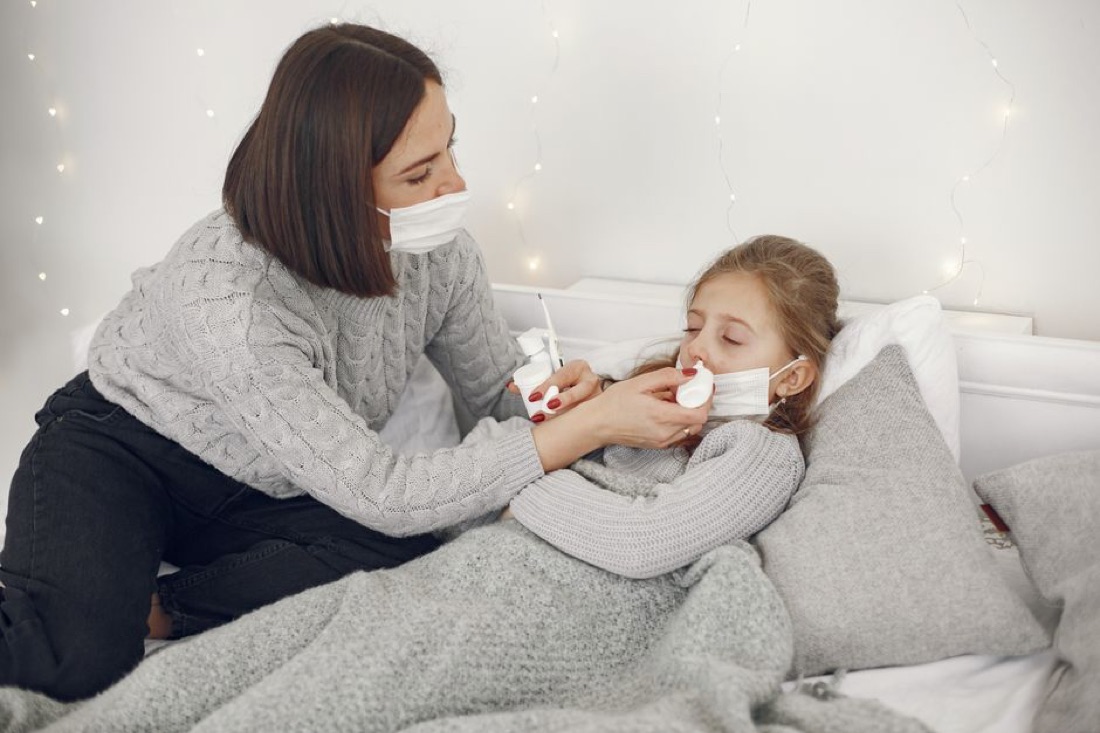
- Nasal irrigation with saline: the most valuable and most neglected step of treatment. It thins the secretions and helps the sinus openings to open. It can be applied several times a day — drops plus an aspirator in babies, spray or irrigation in older children.
- Plenty of fluids and humidifying the room
- Raising the head end slightly (in babies, from under the mattress, on a flat bed)
- Paracetamol or ibuprofen for pain and fever, at the dose recommended by your doctor
- A strictly smoke-free environment
Do not do the following on your own: long-term use of decongestant nose drops (they cause rebound congestion), cough syrups under the age of 6, or giving half doses of leftover antibiotics from home.
Antibiotics
Antibiotics are started when one of the three scenarios above is met and after a medical assessment. The first choice is usually amoxicillin or amoxicillin-clavulanate at an appropriate dose; the duration and dose are determined by the child's age, weight, severity of the attack and previous antibiotic use. A clear improvement is expected within 48-72 hours of starting treatment; if there is no response, the treatment is reviewed.
The critical point is this: stopping the medicine as soon as the child gets better leads to incomplete treatment and paves the way for recurrent attacks. The prescribed course must be completed.
In some mild, persistent cases, if the child looks well, the doctor may recommend 3 days of close observation instead of antibiotics. This is not negligence; it is a strategy to avoid unnecessary antibiotics.
When Should You See a Doctor?
See a paediatrician without delay in the following situations:
- If the runny nose and cough have lasted more than 10 days with no improvement at all
- If the child had started to recover and then develops fever again and gets worse
- If a fever of 39°C or above together with thick nasal discharge lasts 3 days or longer
- If there is severe headache, waking up because of pain, or pain that does not respond to painkillers
The following findings require emergency assessment; they may suggest spread of the sinusitis to the area around the eye or inside the skull:
- Swelling and redness of the eyelid, or the eye appearing to bulge forward
- Pain or restriction of eye movements, double vision or disturbed vision
- Swelling and softening over the forehead
- Neck stiffness, persistent vomiting
- Drowsiness, confusion, extreme irritability, seizures
- Rapid deterioration in the child's general condition
These findings are rare, but they are situations in which no time should be lost.
Looking for the Underlying Cause in Recurrent Sinusitis
In a child who has several sinusitis attacks a year, the question should no longer be "which antibiotic?" but "why does it keep coming back?". What should be investigated:
- Allergic rhinitis — it makes the swelling of the mucous membrane permanent; if there is constant nasal congestion, sneezing and itching, it must definitely be assessed. You can find the details in our article on allergic rhinitis (hay fever).
- Enlarged adenoids, snoring and sleeping with the mouth open
- Passive exposure to cigarette smoke
- A dry and dusty indoor environment
- Rare conditions: structural nasal problems, immune deficiencies, cystic fibrosis, disorders of ciliary movement
This assessment is a natural part of regular child follow-up; when growth, nutrition and respiratory health are monitored together, recurring problems are resolved earlier. These topics are reviewed routinely during well-child follow-up.
In Summary
- In children, sinusitis is usually the continuation of a prolonged cold; it does not have a separate onset.
- It is not the colour of the discharge but its duration and course that matter.
- Complaints lasting more than 10 days without improvement, worsening again during recovery, and a severe onset with high fever are the warning scenarios.
- Nasal irrigation is the basis of treatment; when antibiotics are needed, they must be used at the right dose and for the full course.
- Swelling around the eye and severe headache require emergency assessment.
- In recurrent sinusitis, allergies and adenoids must definitely be investigated.
To evaluate together the cause of your child's persistent runny nose, night-time cough or recurrent sinusitis attacks, you can make an appointment at our practice in Gaziantep. For information about our clinic and how to reach us, you can visit our Gaziantep paediatrician page.
This article is for information purposes only; it does not replace a medical examination. Always consult your doctor before starting any medication for your child.
Frequently Asked Questions
With a simple common cold, the runny nose and cough usually improve noticeably within 7-10 days. If the complaints go beyond 10 days with no sign of improvement at all, or if the child starts getting better around day 5-6 and then worsens again, sinusitis comes to mind. In that case the child should be examined.
No. Discharge turning yellow and then green is the natural result of the defence cells fighting the viruses, and it is common around day 3-4 of a cold. Colour alone is not enough to justify antibiotics. What matters is the duration, course and severity of the complaints.
In uncomplicated sinusitis, X-rays or CT scans are not routinely recommended; the diagnosis is made from the history and physical examination. Imaging is reserved for special situations such as suspected spread to the area around the eye or inside the skull, recurrent severe attacks, or surgical planning.
Because the maxillary (cheek) and ethmoid (bridge of the nose) sinuses are present at birth, sinusitis can also occur in babies. The frontal (forehead) sinuses develop from school age onwards; that is why the classic 'forehead pain' is not expected in small children, and the picture is instead mostly a persistent runny nose and cough.
Yes. Allergic rhinitis causes chronic swelling of the sinus openings and paves the way for recurrent sinusitis. In children who have several attacks a year and whose nose is constantly blocked, an allergy assessment and an examination for enlarged adenoids are appropriate.
📅 Book an appointment for your child's health
Book an online appointment with Specialist Dr. Hasan Keleş in Gaziantep — instant confirmation.
Book an Appointment Online