





 Uzm. Dr. Hasan Keleş
- August 14, 2026
- 6 min read
- Puberty and Metabolism
- — reads
Short stature in children is one of the concerns families raise most often. In the clinic we very often hear phrases like "the shortest in the class" or "he stays smaller than his cousin." Yet height cannot be assessed with a single measurement or by comparing a child with friends. What matters is the child's own growth line, that is, the trend over the years.
In this article I explain the medical definition of short stature, its most common causes, clues that families can follow at home, and the situations in which a doctor should be consulted without delay.
What Does Short Stature Mean Medically?
Not every short child receives a diagnosis of "short stature." The medical definition is clear:
- Percentile: If a child's height is below the 3rd percentile on the growth chart compared with children of the same age and sex, we speak of short stature.
- Growth velocity: Even if the percentile is normal, it matters if the child is growing less than expected each year. Roughly, about 25 cm in the first year, about 12 cm in the second year, and thereafter 5-6 cm per year until puberty.
- Percentile shift: A child who has followed the 50th percentile for years dropping to the 25th and then the 10th is a finding that needs investigation, even if it is "still within the normal range."
Only regular measurements can provide these three pieces of information. That is why height monitoring is one of the most valuable parts of well-child follow-up visits.
How is height measured correctly at home?
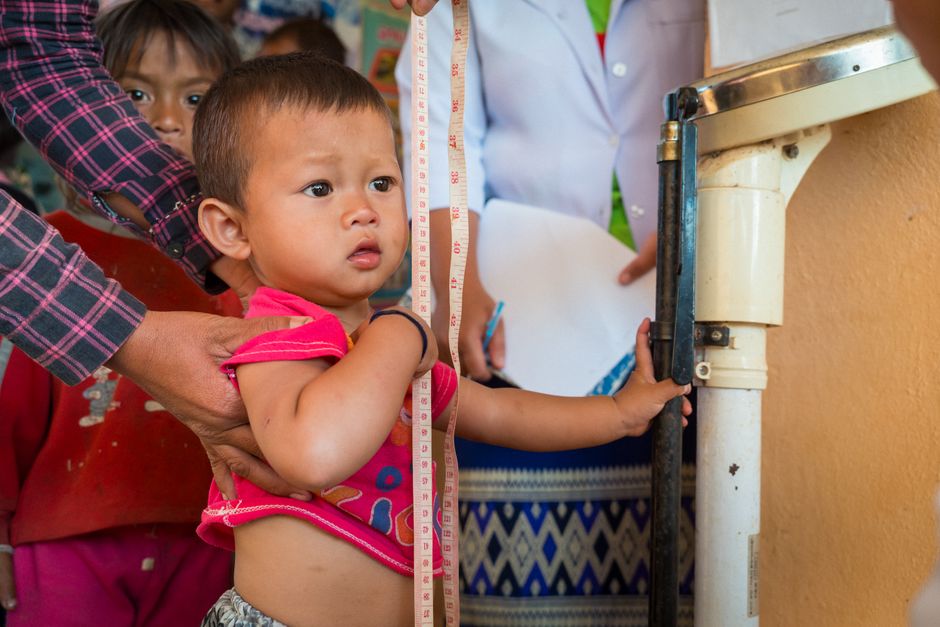
Measurements families bring are often off by a few centimetres, and this is the most common source of the "he isn't growing" worry. For an accurate measurement:
- The child should stand without shoes, heels together, back against a flat wall.
- Heels, buttocks, back and, if possible, the back of the head should touch the wall; the gaze should be straight ahead.
- A flat ruler or book should be placed at a right angle on top of the head and marked on the wall.
- Measurements should always be taken at the same time of day: because the spine compresses during the day, evening height is about 1 cm less than morning height.
- In babies under 2 years of age, length is measured lying on the back, not standing.
Measuring monthly is unnecessary; growth is a slow process. A measurement every 3-6 months is enough to see the trend.
How is target height calculated?
As a rough estimate, a child's genetic potential can be calculated from the parents' heights:
- Boys: (mother's height + father's height + 13) ÷ 2
- Girls: (mother's height + father's height − 13) ÷ 2
The target height range is roughly ±8.5 cm around the resulting figure. If the child's growth curve is consistent with this range, the picture is usually more reassuring; if it is clearly below, the reason should be investigated.
The Most Common Causes
The causes of short stature are broadly divided into "a variant of normal" and "an underlying problem." The good news is this: the vast majority of children have no illness.
1. Familial (genetic) short stature
The mother, father or close relatives are short. The child grows at a steady rate, bone age matches chronological age, and puberty starts on time. Adult height resembles that of the family. This is not a disease.
2. Constitutional delay of growth and puberty
This is what we call a "late bloomer." The child is shorter than peers, bone age is behind, puberty starts late, but the child grows for a longer period and usually reaches a normal adult height. A similar family history (the father growing late, the mother having her first period late) is often present. We explained the normal timing of puberty and its early and late onset in detail in our article on puberty.
3. Inadequate nutrition and iron deficiency
Insufficient calorie-protein intake, extremely picky eating, and prolonged iron or zinc deficiency slow growth. These are among the most easily corrected causes of short stature. In this picture weight is usually affected first, then height: if the weight curve has started to fall while height is preserved for a while, a nutrition-related problem is one of the first things to consider.
4. Chronic illnesses
Any long-standing illness can put the brakes on growth:
- Coeliac disease (sometimes short stature is its only sign)
- Inflammatory bowel diseases, chronic diarrhoea
- Kidney failure, congenital heart disease
- Uncontrolled asthma, recurrent severe infections
- Poorly controlled type 1 diabetes
5. Hormonal causes
These are uncommon, but because they are treatable they must always be ruled out:
- Hypothyroidism: A deficiency of thyroid hormone markedly slows growth; you can find the details in our article on thyroid problems in children.
- Growth hormone deficiency: Height is short, growth velocity is low, and the child usually looks short for his or her weight.
- Excess cortisol (Cushing's): Typically height stops while weight increases. For this reason, in children whose height has stalled but who are rapidly gaining weight, the picture must be distinguished from simple childhood obesity — most obese children are, on the contrary, taller than their peers.
6. Birth-related causes
Some babies born with intrauterine growth restriction (SGA) catch up with their peers in the first 2-3 years; children who do not catch up need follow-up. In premature babies, corrected age is used for the first 2 years.
7. Genetic and skeletal problems
In conditions such as Turner syndrome (in girls, sometimes short stature is the only sign), Down syndrome and skeletal dysplasias, the trunk-to-leg ratio may be disturbed; a disproportionate shortness stands out.
8. Psychosocial causes
Severe neglect, chronic stress and serious sleep disruption can suppress growth. Because a significant part of growth hormone is secreted during deep sleep, regular and sufficient sleep is important for every child.
When Should You See a Doctor?
If any of the following findings is present, short stature should not be postponed with "it's expected, he'll grow" — it should be evaluated:
- Height below the 3rd percentile on the growth chart
- Crossing percentile lines downwards over the years (for example dropping from the 50th to the 10th)
- Growing less than 4 cm a year after the age of 3
- Height remaining clearly below the target range calculated from the parents' heights
- Disproportion between the limbs and the trunk, or a marked deformity
- No signs of puberty at all by age 13 in girls and 14 in boys
- Rapid weight gain while height has stalled, or conversely weight loss and loss of appetite
- Accompanying findings such as chronic diarrhoea, abdominal bloating, fatigue or pallor
- Short stature together with a history of prolonged jaundice or low blood sugar in the newborn period
Acting early matters in these situations: once bone age advances and the growth plates close, what can be done is limited.
What Happens at the Examination?
The assessment does not proceed with a hasty list of tests, but step by step:
- History: Birth weight and length, nutrition, chronic illnesses, medications used, parents' heights and the timing of their puberty.
- Measurement: Height (with a proper stadiometer, without shoes), weight, sitting height, arm span, head circumference, and plotting on the growth chart.
- Examination: Body proportions, pubertal stage, cardiac-respiratory and abdominal examination, thyroid assessment.
- Bone age: Left hand-wrist X-ray; bone age being behind or ahead of chronological age guides the differential diagnosis.
- Laboratory: Full blood count, sedimentation rate, thyroid tests (TSH, fT4), coeliac screening, kidney-liver tests, urinalysis; if needed IGF-1 and, in girls, chromosome analysis.
- Further evaluation: If deemed necessary, growth hormone stimulation tests together with paediatric endocrinology.
Having measurements taken with the same method and at regular intervals is more valuable than a one-off list of tests.
Areas Where the Family Can Help
Even when no medical cause is found, the basic headings that support growth are these:
- Balanced nutrition: Sufficient protein (milk-yoghurt, eggs, meat, legumes), foods rich in iron and zinc; limiting sugary drinks.
- Sleep routine: An age-appropriate duration and regular hours; a screen-free period before bedtime.
- Physical activity: Regular movement and time outdoors; this also matters for vitamin D.
- Control of chronic illness: Managing asthma, allergies or bowel problems well contributes directly to growth.
- Psychological support: Not making jokes about or comparisons based on the child's height is important for protecting self-confidence.
There is no scientific basis for the claim that the "height-boosting" supplements frequently shared on the internet increase adult height in children without hormone deficiency. Do not use supplements without consulting a doctor.
Misconceptions We Hear Often
- "If he drinks milk, he'll grow taller." Milk and dairy products are important for sufficient protein and calcium, but on their own they do not correct shortness caused by hormone deficiency or chronic illness.
- "Let him do sports, if we sign him up for basketball he'll grow." Movement supports health and appetite; adult height, however, is determined by genetics and the state of the growth plates.
- "He'll shoot up in puberty anyway." The pubertal growth spurt does increase height, but a child who is already short at the start of the spurt mostly stays short. Waiting may only delay the diagnosis.
- "Early puberty is good, they grow fast." Quite the opposite: in early puberty the child quickly overtakes peers, but because bone age also advances rapidly, growth closes early and adult height may end up short.
- "Growth hormone injections make everyone taller." Growth hormone is a prescription treatment used only for specific diagnoses and after specialist assessment; unnecessary use has side effects.
In Summary
With short stature, the real question should not be "how many centimetres is my child?" but "is he growing along his own line?" With regular measurement, growth chart follow-up and timely tests when needed, most causes can be identified; and treatable causes give the best results when caught early.
In Gaziantep you can book an appointment for your child's height-weight follow-up and growth assessment; you can find all of our services in the region on the Gaziantep paediatrician page.
Frequently Asked Questions
Height is not judged by centimetres alone but by the percentile on a growth chart for the child's age and sex. A child whose height falls below the 3rd percentile, or who crosses percentile lines downwards over the years, should be evaluated by a doctor.
Roughly speaking, about 25 cm in the first year, 12 cm in the second year, and an average of 5-6 cm per year between the age of two and puberty. If a school-age child grows less than 4 cm a year, this needs to be investigated regardless of whether the child is short.
Genetic height potential matters; a target height range can be calculated from the mother's and father's heights. However, if the child's height is clearly below this target or growth velocity has slowed, heredity may not be the only reason and an evaluation is essential.
After history-taking and examination, bone age is usually assessed with a left wrist X-ray, along with a full blood count, thyroid tests, coeliac screening and kidney-liver function tests. If needed, growth hormone-related tests and, in girls, chromosome analysis are added.
No. Growth hormone treatment is only considered for specific medical diagnoses, after a paediatric endocrinology evaluation and the necessary tests. Most short children have no hormone deficiency and need no treatment.
📅 Book an appointment for your child's health
Book an online appointment with Specialist Dr. Hasan Keleş in Gaziantep — instant confirmation.
Book an Appointment Online