 Uzm. Dr. Hasan Keleş
- September 7, 2026
- 2 min read
- Growth and Development
- — reads
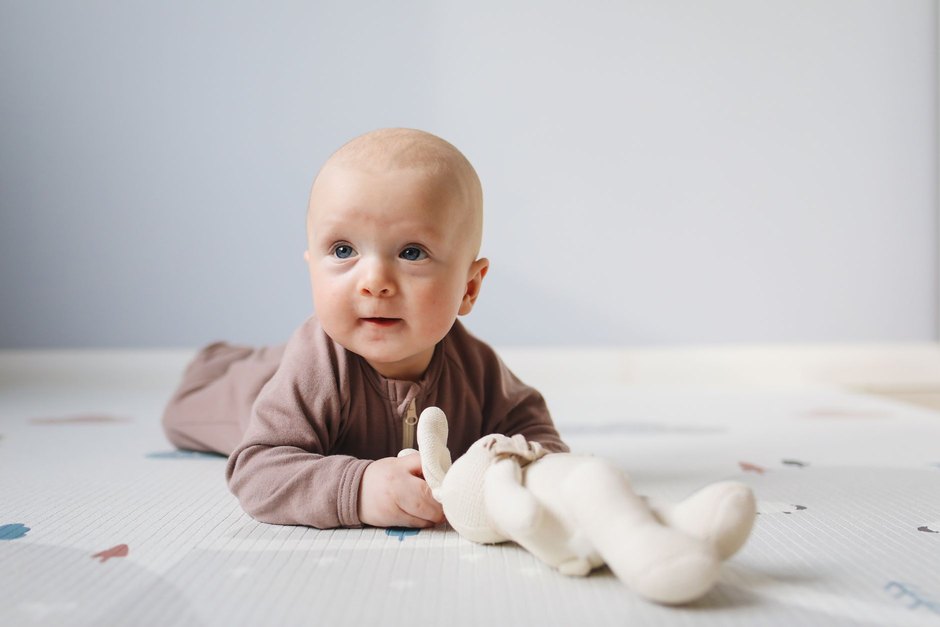
The third month is when a baby discovers their own body. The hands are no longer objects that move at random but parts that can be controlled.
What to expect this month
Social and language
- Back-and-forth exchanges of sound: going quiet when you speak, then making a sound
- Vowel sounds such as "aaa" and "ooo" (cooing)
- Becoming animated and smiling at familiar faces
Movement
- Pushing up on the elbows while on the tummy and lifting the chest
- Holding the head upright for longer
- Bringing the hands together at the midline and looking at them
- Trying to bat at an object held in front of them
Vision
- Following an object through 180 degrees
- Interest in colourful objects and high-contrast patterns
Feeding
Breast milk alone is enough; it is still too early to start solids. Feeding intervals may lengthen a little. Vitamin D supplementation continues. At this age no food other than breast milk or formula is advised — not water, not fruit juice.
Sleep
Night-time sleep begins to lengthen. Some babies have unbroken blocks of 5-6 hours and some do not; both are normal. Three to four short daytime naps are typical. This is a good period to start settling a sleep routine (bath, dim light, the same order each night).
This month's vaccinations
There is no vaccine at month 3 in the national schedule. Vaccines are given at 2, 4 and 6 months. This month is suitable for a well-child check and growth monitoring.
When to see a doctor
- If the head cannot be held upright at all
- If the hands are constantly held in a tight fist and never open
- If there is no response to loud sounds
- If there is no eye contact and faces are not followed
- If the baby makes no sounds at all
- If weight gain has stopped
Previous month: 2-month-old baby development · Next month: 4-month-old baby development
Frequently Asked Questions
Yes. In this period vowel sounds such as 'aaa' and 'ooo' appear, along with back-and-forth exchanges of sound. Going quiet to listen when you speak and then answering with a sound is expected development.
There is no vaccine scheduled for month 3 in the national schedule. Vaccines are given at 2, 4 and 6 months. This month is suitable for a well-child check.
Night-time sleep begins to lengthen, and some babies manage blocks of 5-6 hours. Total sleep is around 14-16 hours. It does not progress at the same pace in every baby.
No. Bringing the hands to the mouth is how a baby explores their own body at this age and is a normal developmental step. It is also the first sign of self-soothing.
📅 Book an appointment for your child's health
Book an online appointment with Specialist Dr. Hasan Keleş in Gaziantep — instant confirmation.
Book an Appointment Online